Friday, October 19, 2012

Strandbeests!

First of all, did you know there was a show called Wallace and Gromit's World of Invention?
I didn't, but now I wish I got bbc1 so I could watch it.

Anyhoo, Theo Jansen builds wind-powered sand creatures. We've discussed early, non-digital computers, so I think I can include these beesties on my blog. 
A few thoughts:

1. They are amazingly beautiful. It has to do with being able to see the mechanics of their skeletons; they move as fluidly as biological organisms but look like machines. I like being able to see the complex series of physical algorithms that must be executed in order to achieve motion.

2. Jansen refers to them as animals and hopes that one day they will be able to "live" on their own on the beach. He's constructed ones that can detect when they hit water, and reverse motion, and ones that detect when a storm is coming and peg themselves to the ground.

3. This makes me think about a different sort of participatory art. Not art that people participate in, but art that participates. You know? We've talked a little bit about artificial intelligence, and Grosser presented to us his painting machine that arguable has its own creative agency. I think Jansen's sand animals bring up a similar idea, that of the machine as thinking organism. Living art. Only with these, they would potentially exist as a community, a herd on the beach. Maybe they could even be designed to make art of their own? Sand sculptures?

4. Of course what sets these apart is that they are powered solely by the wind. So the source of creative agency is the earth itself, in a much more direct way than usual.

Sunday, October 14, 2012

Reload the love!


I liked all of the pieces that Ben Grosser presented in class on Thursday, but found I could relate in particular to "Reload the Love!" I have thought before about how the aesthetics of Facebook condition us. First, there's that soft warm blue theme. That's the same color they paint on the inside of insane asylums to calm the patients down. And then bam! It's punctuated with an exciting pinch of hot orange-red, a chip of chocolate in the vanilla theme. I am entirely aware of how my eyes are magnetized to the top right-hand corner of the screen every time I load my Facebook page; of the fact that I get a little rush each time I see one of those little red virtual goodies light up.

But I never really thought about the totally consumerist pattern of the Facebook notification system. As Grosser points out the crucial thing about notification is that once you click on them, the exciting red number goes away. It works exactly the same as any other mechanism that powers the consumer-culture machine: it conditions you to want something that is short-lived, so that you buy into a system that will supply you with more. So, it conditions you to want notifications -- and the way to get notifications is to post frequently. Facebook thrives off of people posting; the more posts they make, the more time they spend on the site, the more ads they click on, the more brand-pages they "share."

That's all pretty obvious when you think about it but what I like about Grosser's piece is how he hones in on one tiny detail about web-design that essentially powers the whole beast. I think it's a beautiful example of, to use his words "how software [in this case, UI design] prescribes behaviors." It's also intensely creepy. In the past, I've put myself on Facebook-post hiatuses in order to limit my opportunities for time-wastage. It's a lot more boring if you never get any notifications. Now when I do that I will with the consciousness that I'm resisting their system. Which I suppose I can use as an excuse for complying with it in the first place.


Monday, October 8, 2012

The Available World

Mark Amerika's piece Grammatron got me thinking of other uses hyperlink in text I've seen. Most notable is some of the work my one of my creative writing professors, Ander Monson, who apparently in his former life was a hacker but now is an essayist/fiction-writer/poet dude.
One of Ander's preferred ideas is that of the labyrinth, which he applies to his work in various ways. One of his volumes of poetry, The Available World has a companion site , which, like Amerika's piece, uses hyperlinks to create a webby, non-linear literary experience (though I'd contest the classification of Grammatron as literary). Monson's site can be read alone, but it is best experienced as a companion to the physical volume. The website includes some poems that are in the book, and some that aren't.

What I can make from Monson's interest in pairing web and page (which he does with another book, an essay collection, in a different format) is something about non-linearity. I'm still going through it in my head. When you read a book, it's like following a thread. You know that you will see everything the thread sees; even if it doesn't tell you everything, you'll know you read everything it had to say. But a website is different. Part of the fun, and the stress, of reading on the web is the constant need to (literally and figuratively) keep tabs on everything. What are you missing? Where did you start and where did you end? Did you find what you were looking for or forget about it completely?

So what does Monson want to do by offering us both? I'd probably have to read The Available  World a couple more times. As I mentioned in my first post, with poetry form has got interact with content, and I'm still absorbing the poems themselves. But I like the interactivity of his website; the responsibility, you might say, that it puts on the reader to be explore the labyrinth; to make their own adventure.

Saturday, September 29, 2012

Wavefunction


source: http://www.lozano-hemmer.com/wavefunction.php


--> This video appeared in my Facebook news feed the other day. It is a kinetic sculpture that responds to the body movements of the public who walks past it. It's part of whole Surveillance Art exhibit put on in Italy in 2007.
I like this piece because it reacts to the viewer, which makes it seem to have a personality of it’s own. In particular I like that there is a delayed reaction, so that the viewer must turn around to see the effects of their movements on the piece.

I’m curious about the use of chairs. I guess an empty chair suggests human presence, or the idea that humans do occupy this piece even though they aren’t visually represented in it. Also, a block of chairs like this looks like chairs in an a theatre or auditorium, a place where people go to all watch a spectacle. At the same time, the piece itself is a piece of surveillance art, meaning it relies on surveillance technology, which is sort of the opposite of the type of surveillance that happens in a theatre or an auditorium. One is done en masse, directly, and by consent; the other is covert, performed remotely through the use of machine, often without the consent of those being watched. There’s something strange here about how the surveillance aspect of the piece affects (causes movement in) the empty, plastic chairs (which may imply an empty plastic public?).

Rafael Lozano-Hemmer says in his artist’s statement:

The idea of a 'function' as a field for artistic experimentation is a motivation for this piece. Other references include: the mathematics of dynamic systems, capable of generating complex non-linear, behaviours, the materialisation of surveillance and turbulence and the anti-modular reinterpretation of the work of modern designers such as Charles and Ray Eames.

I like the idea of the “materialization of surveillance and turbulence,” that we can create art that manifests the invisible act of watching. Also, that the piece involves the generation of complex movement would qualify it as displaying Class 4 behavior according to Wolfram’s classifications, which as we discussed in class, seems to be the most pleasing type of behavior in art.

Friday, September 14, 2012

Introduction to net.art


As I mentioned in my last post, I have a thing for the tongue-in-cheek and the ironically self-aware. The piece pictured above is Introduction to net.Art by Alexei Shulgin and Natalie Bookchin. It consists of a outline-format guide to becoming a net artist and includes section headings such as "Critical Tips and Tricks for the net.artist" and "Utopian Appendix (after net.art)". In 1999 it was engraved in stone (Rhizome). 

I particularly like the "Critical Tips and Tricks" section: 


exerpt from Introduction to net.art (1997), Shulgin & Bookchin

I chose this piece because I think it successfully achieves what I going for with my Instructables piece, which I wasn't entirely satisfied with.

I think it is important that art movements be capable of making fun of themselves. Here, the artists are humorously pointing out all the potential traps net.artist may fall into: excessive preoccupation with hits on one's site, extreme pretentiousness, and egoistic pride in one's own exceptionalism -- the kinds of things artists of any generation may on occasion be found guilty of (except that first one I guess).

But I like this piece as well because of its form. They could have written a manifesto in long rambling paragraphs, but chose instead to break it up into an outline. What is more, though net.art consists of entirely digital media, they chose to engrave the piece in stone -- one of the most ancient means of publishing there is. It's almost as if they are feigning insecurity – as if they are satirizing a net.artist who secretly lacks confidence in the durability of his medium and thus ultimately wants to fall back on archaic methods to make heard his manifesto.

There's something deliciously ironic about creating an outline to describe an art process. When I wrote my instructable, I was thinking about the irony of using a DIY website format to give instructions on how to make profound art (and having the product created be something that is, if possible, even more silly than the source material). I am not sure what creativity is, or how it happens, or where it lies, but I am sure that it doesn't break down into something that looks like lecture notes.

Introduction to net.art attempts to reign in the potential arrogance of the avant-garde. Whenever you a group of artists identify themselves as a movement, they risk allowing their philosophy and politics to outrun their actual acts of creation. What I like about this piece is how it navigates not only the larger questions of how to be hip without being hipster, but also hones in specifically on the digital artist's task of asserting the validity of their work as it exists virtually, entirely independent from physical creation.


Monday, September 10, 2012

DuChamp & excellent shenanigans


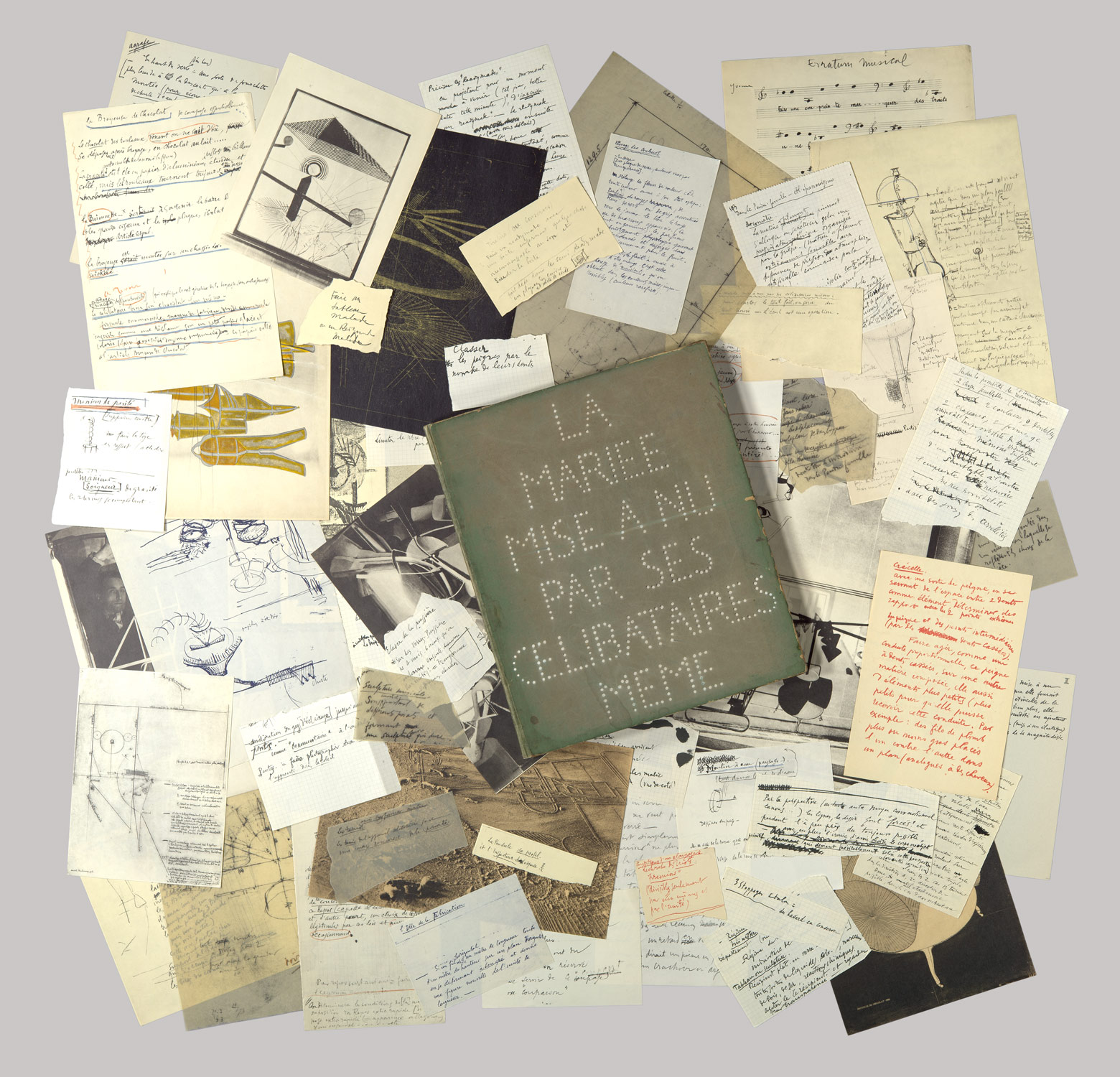
The Bride Stripped Bare by Her Bachelors, Even (The Green Box), September 1934
Marcel Duchamp


DuChamp was a funny guy.  The more I learn about him, the funnier he gets. Fountain may be Duchamp's most widely-known piece, but it is not the one that he considered to be representative of his life's work. That honor goes to his multi-media sculpture, The Bride Stripped Bare by her Bachelor's, Even (The Large Glass):

The Bride Stripped Bare by Her Bachelors, Even (The Large Glass),  1915-1923

It is an insanely complex piece of work, both physically and metaphysically. You can read the details at the link provided, but essentially, it's two big sheets of glass (one of which was at one point shattered in transit and then re-assembled) jazzed up with a bunch multi-media funkiness. Apparently all of the strange shapes and holes and designs in the glass are meant to diagram a soapy story about a bride and all her bachelors and some shenanigans they get up to. It's weird. It's pretty cool. I'd like to see it. But it's actually not the focus this post, not exactly.

DuChamp started work on The Bride Stripped Bare in 1916 and in 1923 declared it "definitively unfinished." Perhaps this was partially referring to DuChamp's feeling that the physical realization of the glass was only a part of the whole work. Indeed, in 1934 he published facsimiles of 94 items from the notes he had relating to the piece, which were meant to be its necessary companion. His biographer, Calvin Tomkins, wrote:

Duchamp had always maintained that his Glass was not just something to be looked at but "an accumulation of ideas," in which verbal elements were at least as important as visual ones, perhaps even more so. [...] As Duchamp would say in a 1959 interview, he had "tried in that big Glass to find a completely personal and new means of expression; the final product was to be a wedding of mental and visual reactions; in other words, the ideas in the Glass were more important than the actual visual realization." Since the ideas were contained (more or less) in the notes, their long-delayed publication would become a new chapter in the continuing saga of his unfinished, shattered, but far from defunct masterpiece.
He called the collection of 94 facsimiles The Green Box (pictured above), and published 320 copies.  He made a big deal out of letting every one know that he had been meticulous – obsessive, even – in his efforts to make every copy exactly like the original, down to using exactly the same ink and going on epic searches for exactly the same type of paper. He boasted about how completely and totally identical all 320 copies of 94-piece set were.

Critics have had a lot to say about this. That is, they have had a lot to say about the fact that he tried so hard to make all his copies exactly the same. They've gone nuts analyzing what that meant about The Bride Stripped Bare and about DuChamp. No one ever actually asked if really had done what he said he did (well, eventually some one did). What I mean is, no one ever bothered to look at the copies to see if DuChamp really did reproduce 320 copies that were identical to the original.

Guess what? He didn't. In fact, it seems he when to painstaking efforts to make all 320 copies totally different. Yeah. He repeatedly emphasized all the trouble he had gone through to make them the same... and actually did the exact opposite.

Evidently, he was intentionally playing games with the artistic establishment in his publication of The Green Box. He was trying to get them talking (and talking and talking and feeling very smart) about something that wasn't even true; he was trying to make them think that they had found meaning in something that didn't even exist. He said: here's the key to understanding my Art; I'll publish it in limited edition form, so people scramble to get their hands on it, and spend a lot of time analyzing what it means that I spent so much time reproducing these exact copies.

DuChamp's genius, or insanity, is in how far he went in order to prove that when Art is encrusted with the establishment, it's physical reality ceases to mean anything. What matters then is what people think about it. He makes a big glass full of funny shapes, and tells us it's a weird erotic scene between a lady and her panting suitors. We stop seeing that it's actually just a big glass full of funny shapes (albeit a really interesting and complicated glass full of shapes), and start Talking About What It Means. He publishes 320 completely different versions of his notes on the work and tells us their identical, and we start reading into what it means that they're identical. Never mind that they actually aren't.

(He puts a urinal in a museum and says it's art, and we all start talking about it like it is).


It is easy to be wearied by contemporary art that indulges too heavily in this kind infinite spiral of self-skepticism, self-reference, self-mockery. Sometimes you just want a painting to be an effing painting. But then, art has always been a means of revolt – DuChamp was not the first to take action against the Artistic Authority. But what makes his revolt different that previous ones is that the piece itself – not its technique or subject matter but the physical object itself – was the vehicle for criticism. People's reactions to and thoughts about The Green Box are as much the art piece as is the box itself.

It may relate only tangentially to computing, but I think that DuChamp's interest in the reaction of his audience – his insistence that the response is itself the art, and that the object he creates is merely a vehicle – does lend him a kinship with generative artists.


Saturday, September 1, 2012

More sestinas than there are particles in the known universe

-->
Last summer I volunteered to be a driver for the U of A Poetry Center’s Poetry Off the Page Symposium. I was assigned to the poet Dan Waber and his wife Jennifer Hill.

I looked Waber up before I picked him and his wife at Tucson International. I discovered that he runs a nonprofit chapbook publishing website, is the author of several books of poetry, publishes a visual poetry series, and is generally a mad scientist when it comes to digital and concrete poetry.

But perhaps the coolest thing he’s done – in both my and his own opinion – is write more sestinas than there are particles in the known universe. That is to say, he’s written an algorithm (in the form of some perl code) that has generated more sestinas than there are particles in the known universe.
To be specific, 9.103 x 10131 sestinas.

A sestina is a 39-line form (6 sestets and an ending tercet) that involves an intricate pattern of repeated words.

All 9.103 x 10131 of Waber’s sestinas use the same 6 words as line-ending words. All of them use the same fragments of language, repeated and recombined in an unimaginably huge number of iterations.

It’s hard for be to break down exactly why I love this project so much. Like all good poetry (and good art) it works in multiple dimensions.

The sestina, because of its kind of bizarre pattern of repeated words, is a great form for talking about unresolvable problems. You have this echo of words that seem to spiral around a central knot. As Waber puts it: “A sestina feels to me like a fall through a system of cycles.” (You’ve really got to read a few sestinas to see what I mean: Heaney, Bishop, Auden).

What’s brilliant about Waber’s project is that it takes the effect of a single sestina – that circular dance of repeated words – and hyperbolizes it beyond belief. I own ten of the sestinas. Obviously he hasn’t physically – or even digitally – published them all (physically, you’d have to deforest large sections of the planet in order to produce the paper to do that; I am less sure of what the task of digitally producing them all would involve); you have to custom order a specified number directly from his website, though mine I received as a gift after being his driver. I like this too, because it brings in an element of audience participation. Sure, it’s not quite as much involvement as some of the pieces we’ve discussed in class, but the reader must still decide how many sestinas they would like (the more you order, the better you’ll grok the whole thing – but the more work you have to do, as reading each sestina is itself a project). And then you have to personally contact Waber to request the sestinas.

So what do you get if you order a selection?
Just as in a single sestina, the same six words repeat throughout the poem, in Waber’s collection of sestinas, the same fragments of phrases repeat to make up all 9.103 x 10131 poems. He somehow managed to perfect the code so that it randomly recombines his fragments and still always makes grammatical sense.

So all 9.103 x 10131 sestinas are alike but different. All of them follow a slightly different orbit around a nuclear experience or truth or emotion. The more of them you read, the more the language enacts the experience it’s trying to convey. That is, one thing that we (poetry students; I’m a creative writing major with an emphasis in poetry) learn is important in poetry writing is to think about how our form must enact, must enforce, must essentially be inseparable from content. So Waber is writing about a time in his life when he is frustratingly caught going back and forth between worlds; where he is constantly approaching and then leaving where he wants to be; where the routine that he’s following both confines and defines him.

That’s exactly the set form of a sestina does for a poet; it both constrains and articulates meaning. 

Waber's sestinas are successful because they are not just the result of a gimick. He didn't just do to prove he could write computer code that generates poetry. He did it because he realized that by writing code that generates poetry, he could express something about life in a unique and powerful way.

I should mention, too, that all of them are love poems.